
SPJ Code of Ethics
Revised September 6, 2014 at 4:49 p.m. CT at SPJ’s National Convention in Nashville, Tenn.
 Download a printable copy [PDF]:
8.5x11 flyer | 11x17 poster | Two-sided bookmark
Preamble
Members of the Society of Professional Journalists believe that public enlightenment is the forerunner of justice and the foundation of democracy. Ethical journalism strives to ensure the free exchange of information that is accurate, fair and thorough. An ethical journalist acts with integrity.
The Society declares these four principles as the foundation of ethical journalism and encourages their use in its practice by all people in all media.
Seek Truth and
Report It
Ethical journalism should be accurate and fair. Journalists should be honest and courageous in gathering, reporting and interpreting information.
Journalists should:
- Take responsibility for the accuracy of their work. Verify information before releasing it. Use original sources whenever possible.

- Remember that neither speed nor format excuses inaccuracy.
- Provide context. Take special care not to misrepresent or oversimplify in promoting, previewing or summarizing a story.
- Gather, update and correct information throughout the life of a news story.
- Be cautious when making promises, but keep the promises they make.
- Identify sources clearly. The public is entitled to as much information as possible to judge the reliability and motivations of sources.
- Consider sources’ motives before promising anonymity. Reserve anonymity for sources who may face danger, retribution or other harm, and have information that cannot be obtained elsewhere. Explain why anonymity was granted.
- Diligently seek subjects of news coverage to allow them to respond to criticism or allegations of wrongdoing.
- Avoid undercover or other surreptitious methods of gathering information unless traditional, open methods will not yield information vital to the public.
- Be vigilant and courageous about holding those with power accountable. Give voice to the voiceless.
- Support the open and civil exchange of views, even views they find repugnant.
- Recognize a special obligation to serve as watchdogs over public affairs and government. Seek to ensure that the public’s business is conducted in the open, and that public records are open to all.
- Provide access to source material when it is relevant and appropriate.
- Boldly tell the story of the diversity and magnitude of the human experience. Seek sources whose voices we seldom hear.
- Avoid stereotyping. Journalists should examine the ways their values and experiences may shape their reporting.
- Label advocacy and commentary.
- Never deliberately distort facts or context, including visual information. Clearly label illustrations and re-enactments.
- Never plagiarize. Always attribute.
Minimize Harm
Ethical journalism treats sources, subjects, colleagues and members of the public as human beings deserving of respect.
Journalists should:
- Balance the public’s need for information against potential harm or discomfort. Pursuit of the news is not a license for arrogance or undue intrusiveness.
- Show compassion for those who may be affected by news coverage. Use heightened sensitivity when dealing with juveniles, victims of sex crimes, and sources or subjects who are inexperienced or unable to give consent. Consider cultural differences in approach and treatment.
- Recognize that legal access to information differs from an ethical justification to publish or broadcast.
- Realize that private people have a greater right to control information about themselves than public figures and others who seek power, influence or attention. Weigh the consequences of publishing or broadcasting personal information.
- Avoid pandering to lurid curiosity, even if others do.
- Balance a suspect’s right to a fair trial with the public’s right to know. Consider the implications of identifying criminal suspects before they face legal charges.
- Consider the long-term implications of the extended reach and permanence of publication. Provide updated and more complete information as appropriate.
Act Independently
The highest and primary obligation of ethical journalism is to serve the public.
Journalists should:
- Avoid conflicts of interest, real or perceived. Disclose unavoidable conflicts.
- Refuse gifts, favors, fees, free travel and special treatment, and avoid political and other outside activities that may compromise integrity or impartiality, or may damage credibility.
- Be wary of sources offering information for favors or money; do not pay for access to news. Identify content provided by outside sources, whether paid or not.
- Deny favored treatment to advertisers, donors or any other special interests, and resist internal and external pressure to influence coverage.
- Distinguish news from advertising and shun hybrids that blur the lines between the two. Prominently label sponsored content.
Be Accountable and Transparent
Ethical journalism means taking responsibility for one’s work and explaining one’s decisions to the public.
Journalists should:
- Explain ethical choices and processes to audiences. Encourage a civil dialogue with the public about journalistic practices, coverage and news content.
- Respond quickly to questions about accuracy, clarity and fairness.
- Acknowledge mistakes and correct them promptly and prominently. Explain corrections and clarifications carefully and clearly.
- Expose unethical conduct in journalism, including within their organizations.
- Abide by the same high standards they expect of others.
Now available: Media Ethics: 5th Edition
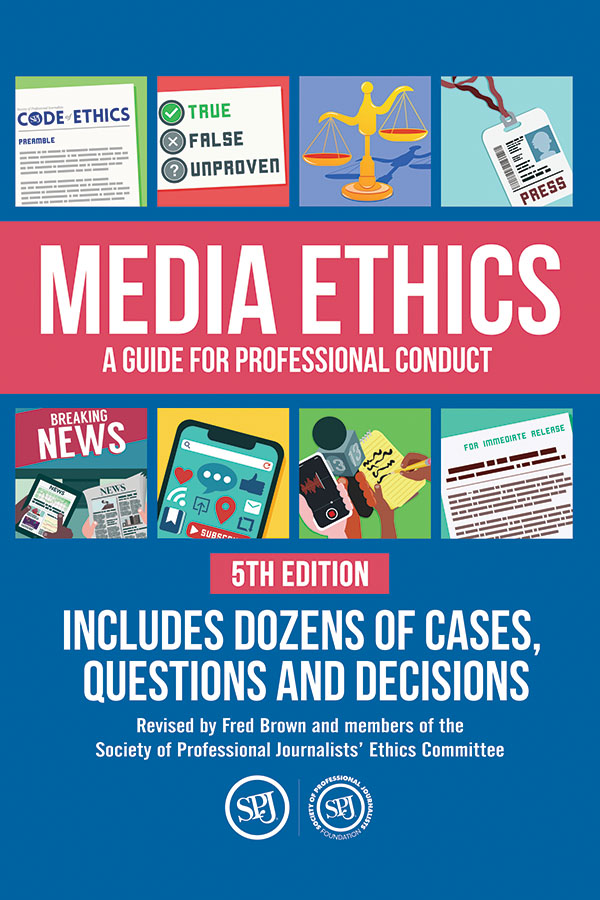 Closely organized around SPJ's Code of Ethics, this updated edition uses real-life case studies to demonstrate how students and professionals in journalism and other communication disciplines identify and reason through ethical dilemmas.
Order now:
The SPJ Code of Ethics is a statement of abiding principles supported by explanations and position papers that address changing journalistic practices. It is not a set of rules, rather a guide that encourages all who engage in journalism to take responsibility for the information they provide, regardless of medium. The code should be read as a whole; individual principles should not be taken out of context. It is not, nor can it be under the First Amendment, legally enforceable.
For an expanded explanation, please follow this link.
Supporting documents
Click or tap the arrow icon anywhere it appears in the code to explore additional resources the Society’s ethics committee compiled to help people with day-to-day ethics decisions. Links will open in their own window.
 Translations
- Arabic [PDF]
- Chinese [PDF]
- French [PDF]
- German [PDF]
- Persian [PDF]
- Portuguese [PDF]
- Russian [PDF]
- Spanish [PDF]
Additional Applications
SPJ Ethics Committee Publications
Additional Resources
- What the Codes Say: Code provisions by subject
- Other codes of ethics
- FAQ
- Ethics Hotline
- Contact the Ethics Committee
Get involved
History
The SPJ Code of Ethics is a statement of abiding principles supported by additional explanations and position papers that address changing journalistic practices. It is not a set of rules, rather a guide that encourages all who engage in journalism to take responsibility for the information they provide, regardless of medium. The code should be read as a whole; individual principles should not be taken out of context. It is not, nor can it be under the First Amendment, legally enforceable.
Sigma Delta Chi's first Code of Ethics was borrowed from the American Society of Newspaper Editors in 1926. In 1973, Sigma Delta Chi wrote its own code, which was revised in 1984, 1987, 1996 and 2014.
The committee that revised the Society’s Code of Ethics in 2014 recognized the need to provide additional information and commentary about the Code’s four overarching values and 35 individual principles. This online version of the Code includes dozens of links that provide additional context, especially regarding ethical journalism practices in the context of new technology and the evolving cultural landscape.
These links are not part of the Code, and they will change as more new resources are found and older resources become obsolete.
Email questions and suggestions to the Society’s Ethics Hotline.

SPJ News
- Announcing the 2024 recipients of The Liberty Awards
- SPJ partners with Aquiline Coaching to offer self-care and wellness resources to members
- SPJ ethics leaders decry editorial interference at LA Times and Washington Post amid debate over presidential endorsements
Events and Deadlines
- 11/20/24: SEO 101: What Every Journalist and Publisher Should Know
- 11/24/24: SPJ + Aquiline Universal Newsroom Biweekly Chat
- 12/01/24: Entries Open: New America Award
- 12/03/24: SPJ Georgia: A Winter Wonderland
- 12/05/24: Entry deadline for the Lukas Prize Project